
Imperial Golden Triangle Tour with Amritsar — 8 Days Through India’s Icons, Golden Temple & Living Heritage
Duration
8 Days / 7 Nights
Location
Delhi › Agra › Jaipur › Amritsar
Overview
India's Golden Triangle is often considered the perfect first introduction to the country — but extending it to Amritsar creates a far richer and more meaningful journey. Over eight carefully designed days, this private Imperial Golden Triangle Tour with Amritsar combines India's most iconic landmarks with one of its deepest spiritual and historical destinations.
Begin in Delhi, where ancient empires and colonial avenues reveal the country's layered past. Continue to Agra for the timeless beauty of the Taj Mahal, then on to Jaipur, where Rajasthan's hilltop forts, royal courtyards, and pink sandstone façades capture India's regal imagination. Finally, travel north to Amritsar — where the shimmering Golden Temple, the solemn history of Jallianwala Bagh, and the electrifying Wagah Border ceremony reveal a profoundly different and deeply moving side of India.
This itinerary is crafted for international travellers who want more than monuments alone. It is a journey through architecture, faith, resilience, and identity — designed with private transport, curated hotels, expert local guides, and pacing that allows each destination to feel distinct rather than rushed.
If your schedule allows only the core circuit, our 5-day Golden Triangle private tour covers Delhi, Agra and Jaipur in the ideal balance of depth and efficiency — the natural foundation for this extended journey.
Tour Highlights
-
Private chauffeur-driven journey throughout Delhi, Agra, Jaipur & Amritsar
-
Guided exploration of Old & New Delhi
-
Taj Mahal sunrise or sunset experience
-
Agra Fort (UNESCO) and Fatehpur Sikri en route
-
Amber Fort, Hawa Mahal, City Palace & Jantar Mantar, Jaipur
-
Golden Temple (Harmandir Sahib) — spiritual immersion
-
Jallianwala Bagh — memorial and historical reflection
-
Wagah Border Beating Retreat Ceremony
-
Heritage hotels and curated boutique stays
-
Architecture, spirituality, history & culture — all in one journey
Day Wise Itinerary
Day 1 Arrival in Delhi — Welcome to India’s Capital
Your journey begins in Delhi — India's historic gateway and a city where multiple civilisations have shaped one extraordinary capital. On arrival at Indira Gandhi International Airport, a private representative meets you with a name board and transfers you comfortably to your hotel.
The first day is intentionally relaxed, allowing time to recover from international travel while adjusting to India's atmosphere. Depending on your arrival time, optional evening experiences include a gentle stroll around India Gate and the illuminated Kartavya Path, Connaught Place's colonial arcades, or the serene Lodhi Garden — a soft and unhurried entry point to the city before the itinerary begins in earnest tomorrow.
Overnight: Delhi
Day 2 Old & New Delhi — Mughal Legacy to Imperial Grandeur
Morning — Old Delhi: Begin at Jama Masjid — Shah Jahan's great congregational mosque, completed in 1656, with a courtyard accommodating 25,000 worshippers. Explore Chandni Chowk by cycle-rickshaw, weaving through spice lanes, silver markets and colonial-era sweet shops that have traded here for over 350 years. Drive past the imposing sandstone facade of Red Fort (exterior), then stop at Raj Ghat — the black marble platform marking Mahatma Gandhi's cremation site on the Yamuna's west bank.
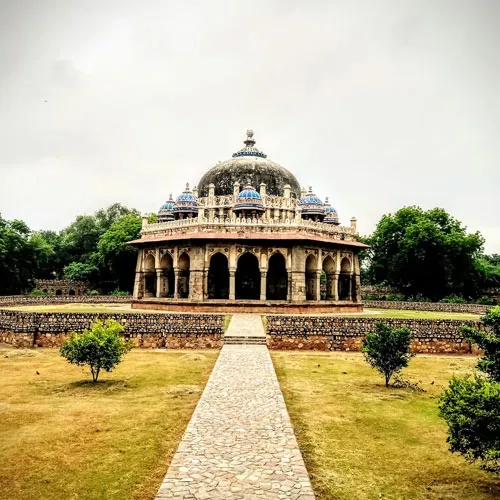
Afternoon — New Delhi: Visit Humayun's Tomb — the 1570 UNESCO World Heritage mausoleum that architecturally prefigured the Taj Mahal with its Charbagh garden, white marble dome and red sandstone composition. Continue to Qutub Minar — the 73-metre UNESCO-listed victory tower begun in 1193, flanked by the 2,000-year-old Iron Pillar. End with a panoramic drive past India Gate, Parliament House, and Rashtrapati Bhavan — Lutyens' grand imperial axis, now the ceremonial core of the world's largest democracy.
Overnight: Delhi
Day 3 Delhi to Agra — The Taj Mahal & Agra Fort
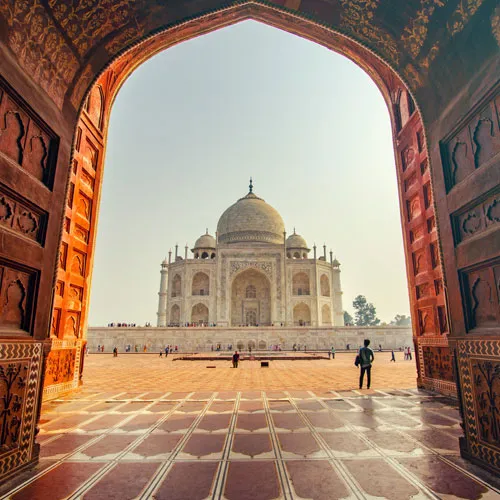
After breakfast, depart for Agra via the Yamuna Expressway — approximately 200 km, around 3 to 3.5 hours. Hotel check-in and a brief rest before your private guide takes you to the Taj Mahal. Entering through the Darwaza-i-Rauza, the great Mughal gateway, what lies beyond has moved travellers for nearly four centuries. Your guide walks you through Shah Jahan's grief after Mumtaz Mahal's death in 1631, the 22-year construction by 20,000 artisans, the extraordinary pietra dura gemstone inlay, and the optical corrections built into the minarets.
Continue to Agra Fort — the UNESCO World Heritage red sandstone citadel that served as the Mughal imperial residence from Akbar to Aurangzeb. Inside: the Jahangiri Mahal, the white marble Khas Mahal, and the Musamman Burj, from which Shah Jahan is said to have gazed toward the Taj in his final captive years. A sunset visit to Mehtab Bagh — the Mughal garden directly opposite the monument — offers a quiet, crowd-free riverfront view. Note: The Taj Mahal is closed on Fridays.
Overnight: Agra
Day 4 Agra to Jaipur via Fatehpur Sikri
Optional early Taj Mahal sunrise visit before breakfast — predawn entry when the marble shifts from pearl grey to warm gold, with the complex almost entirely to yourselves. Strongly recommended for those who want an entirely different encounter with the monument from the previous evening.
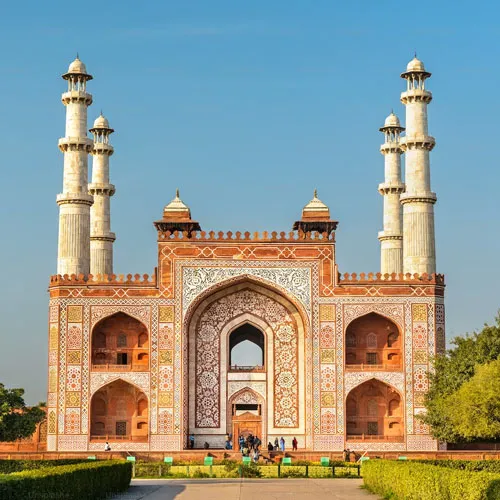
After breakfast and hotel check-out, depart for Jaipur with a guided stop at Fatehpur Sikri — Emperor Akbar's extraordinary red sandstone capital, built between 1569 and 1585 and abandoned within 14 years. Explore Buland Darwaza, the 54-metre ceremonial gateway — the world's largest; Diwan-i-Khas with its unique central column; the five-storey Panch Mahal; and the Salim Chishti Dargah within the Jami Masjid courtyard. Continue to Jaipur. Hotel check-in, then the evening is free for the bazaars — Johari Bazaar for gemstones, Bapu Bazaar for block-print fabrics, or a local cultural dinner.
Overnight: Jaipur
Day 5 Jaipur — Royal Rajasthan & Amber Fort
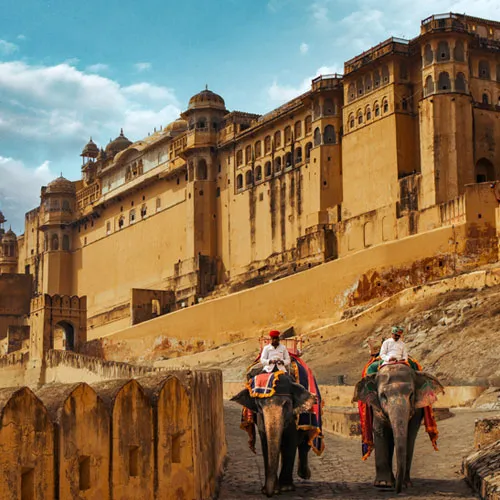
Morning: Visit Amber Fort — the grand Rajput hilltop fortress built by Raja Man Singh I in 1592, ascended by jeep along the old elephant road. Explore the Ganesh Pol gateway, the Sheesh Mahal (Hall of Mirrors), the zenana courtyards, and the Maota Lake panorama below. Photo stop at Jal Mahal — the water palace reflected in Man Sagar Lake with the Aravalli Hills behind it.
Afternoon: City Palace — the royal complex at the heart of the walled city, with its museums of royal costumes, miniature paintings, weapons, and the iconic pair of silver urns (the world's largest silver objects). Next: Jantar Mantar — the UNESCO-listed astronomical observatory with 19 instruments, including the Samrat Yantra, the world's largest stone sundial. End at Hawa Mahal — the 953-windowed pink sandstone screen facade, from which Jaipur's royal ladies once observed street life unseen.
Evening: Optional shopping in Johari Bazaar for Rajasthani gemstones, textiles and lacquerware.
Overnight: Jaipur
Day 6 Jaipur to Amritsar — Rajasthan to Punjab
Today marks the most significant cultural transition of the tour — from Rajput royalty and Mughal grandeur to Sikh heritage, Punjabi identity, and the emotional depth of North India's newest spiritual capital. Transfer to Jaipur Airport (or Delhi if connecting) for a flight to Amritsar — approximately 1.5 to 2 hours. Private transfer to your hotel on arrival.
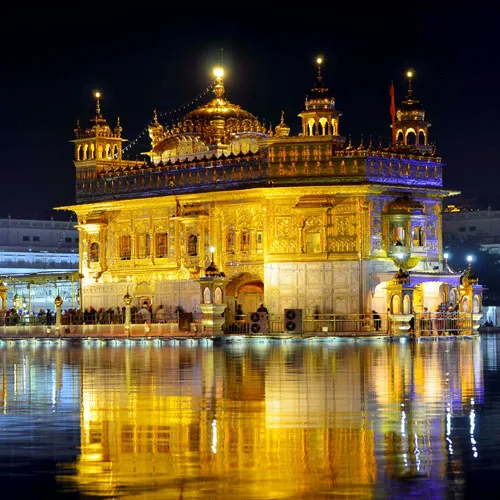
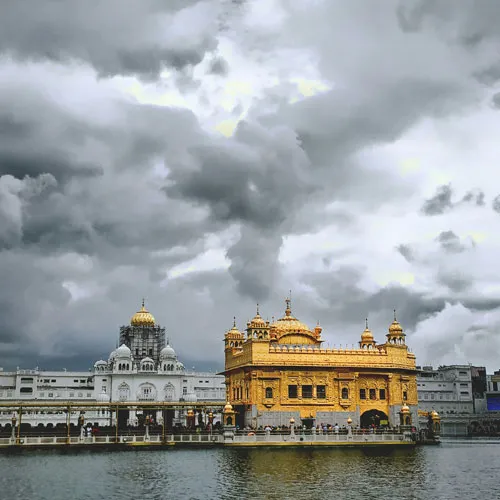
The evening is ideal for a first visit to the Golden Temple, Harmandir Sahib — illuminated after dark, its gold-plated façade reflecting across the sacred Sarovar. The atmosphere at night — quieter, more contemplative, the sounds of kirtan (devotional music) drifting across the water — offers one of India's most serene and memorable first impressions of a spiritual site.
Overnight: Amritsar
Day 7 Amritsar — Golden Temple, Jallianwala Bagh & Wagah Border
This is the emotional and cultural centrepiece of the tour — a day that moves effortlessly between deep spiritual peace and the weight of historical memory.
Morning — Golden Temple: Return to Harmandir Sahib in the morning light. Cover your head, remove your shoes and wade through the cleansing pool at the entrance before crossing the causeway (Guru's Bridge) to the sanctum. The holiest shrine in Sikhism, it was built in its current form under Maharaja Ranjit Singh in the early 19th century, with the gold-plated copper of its upper floors donated by Ranjit Singh himself. Witness the Sarovar — the sacred pool surrounding the temple — at its most luminous in morning sun. Experience the Langar — the community kitchen that has served free meals to all visitors, regardless of faith or background, every day for over 400 years — a living expression of Sikh values of service and equality.
Midday — Jallianwala Bagh: Walk just minutes from the Golden Temple to Jallianwala Bagh — the walled garden where on 13 April 1919, British troops under General Dyer opened fire on an unarmed crowd gathered for Baisakhi celebrations. Between 379 and 1,000 people were killed (estimates vary). The memorial stands on the site, including the bullet-scarred walls and the well into which many jumped to escape. This is not a comfortable place; it is an important one — a critical chapter in the story of India's independence and the moral reckoning of empire.
Optional: The Partition Museum on Town Hall Road offers a deeply researched, profoundly moving account of the 1947 Partition of India and Pakistan, with personal testimonies, archival photographs and artefacts. One of the finest historical museums in South Asia.
Evening — Wagah Border Beating Retreat Ceremony: Drive approximately 30 km to the Wagah Border crossing between India and Pakistan. Every evening at sunset, the Border Security Force of India and Pakistan Rangers perform the Beating Retreat — an elaborately choreographed flag-lowering ceremony combining military precision, nationalistic fervour, and a moment of shared ritual between two countries that have been at war four times. The atmosphere in the grandstand — crowds singing, flags waving, enormous soldiers in ceremonial dress — is unlike any other experience on this itinerary.
Overnight: Amritsar
Day 8 Amritsar — Return to Delhi & Departure
After breakfast, time allowing, there is space for an optional additional morning visit to the Golden Temple in its quietest hours, or a walk through Amritsar's Heritage Street — the restored pedestrian corridor connecting the bus stand to Harmandir Sahib, lined with murals depicting Sikh history. A final Punjabi breakfast is strongly recommended: amritsari kulcha with chole from one of the city's legendary dhabas.
Transfer to Amritsar Airport for your return flight to Delhi or onward destination. Your 8-day Imperial Golden Triangle Tour with Amritsar concludes — a journey that moved from marble and monuments to faith, sacrifice and living tradition.
Inclusions
-
Accommodation of your choice
-
Breakfast
-
Vehicle of your choice
-
Entrance fees
-
All interstate parking fee
-
24 * 7 support
Exclusions
-
International or domestic airfare unless specified
-
Indian visa fees
-
Lunches and dinners unless specified
-
Monument entrance fees unless specified
-
Tips and personal expenses
-
Travel insurance
Explore More Options
- Just want the heritage core? View our Golden Triangle 5 Days itinerary.
- Want to dive deeper into the desert? Explore the Golden Triangle with Rajasthan.
- Interested in spiritual hubs near the Himalayas? Try our Golden Triangle with Haridwar & Rishikesh.
- Short on time? Do a quick Same Day Agra Tour.
- Tailor your perfect trip: Contact our specialists.
Day Wise Itinerary
Is this a private tour?
Yes — fully private throughout. Your own air-conditioned vehicle for the Golden Triangle sector, private local guides in each city, and dedicated transfers at every stage. No shared coaches, no fixed group timing. The itinerary adapts to your pace and preferences.
Why should I add Amritsar to the Golden Triangle?
Amritsar adds a fourth and entirely distinct dimension to the journey — Sikh spirituality, Punjabi culture, colonial-era history, and a living border ceremony that has no equivalent anywhere in South Asia. The Golden Temple, Jallianwala Bagh and Wagah Border each offer experiences that are emotionally and culturally unlike anything on the classic Delhi–Agra–Jaipur circuit. For travellers who want to understand India beyond its Mughal and Rajput identity, Amritsar is an essential addition.
Is the Golden Temple suitable for international visitors of all faiths?
Yes — the Golden Temple is open to all faiths and nationalities. Visitors are asked to cover their heads (scarves are available at the entrance), remove shoes, and wash their feet before entering. The atmosphere is welcoming, inclusive and serene. Your guide will brief you on the customs and etiquette before arrival.
What is the Wagah Border ceremony?
The Wagah Border Beating Retreat Ceremony takes place every evening at sunset at the India–Pakistan border crossing, approximately 30 km from Amritsar. It involves an elaborately choreographed flag-lowering ritual performed simultaneously by the Indian Border Security Force and Pakistani Rangers. The event draws thousands of spectators on both sides and combines military pageantry with intense national sentiment. It is an unmissable and genuinely unique experience.
Can this itinerary be customised?
Absolutely. All our itineraries are private and fully tailored. Popular additions to this route include Haridwar and Rishikesh for Ganga Aarti and yoga retreats, Varanasi for the riverside dawn ceremonies, a Rajasthan extension into Jodhpur and Udaipur, or an additional night in Amritsar for the Partition Museum and further Golden Temple visits. Share your interests and available time — our specialists will design your personalised itinerary.
Plan Your Golden Triangle & Amritsar Journey
From the Taj Mahal to the Golden Temple — this is India's most powerful first-time route, combining Mughal grandeur, Rajput royalty, Sikh spirituality, and national history in eight days of private, thoughtfully paced travel. Few journeys of this length offer such emotional range and cultural depth.
For those who want wildlife alongside heritage, our Imperial Golden Triangle Tour with Ranthambore extends the classic circuit into tiger country — two safaris in Ranthambore National Park with Bengal tigers, leopards and ancient fort ruins on the reserve boundary.
Browse our full range of Imperial Golden Triangle Tour packages — from 3-day highlights to 10-day extensions — to compare routes and find the format that matches your available time and travel priorities.
Share your dates, hotel preferences, and travel style — our India specialists will create your personalised private itinerary within 24 hours.